If you've ever tried to send a bulk SMS campaign and watched messages mysteriously fail to deliver, there's a good chance the issue traces back to one thing: A2P 10DLC compliance. It's one of those terms that sounds technical enough to ignore, right up until it quietly tanks your delivery rate.
A2P 10DLC stands for Application-to-Person 10-Digit Long Code. In plain terms, it's the system carriers use to identify which businesses are sending text messages and confirm those businesses are legitimate before letting their messages through in volume. Think of it as the equivalent of a business license, but for texting.
Why carriers require this in the first place
Text messaging has a 98% open rate, higher than almost any other marketing channel available today. That makes it incredibly effective for businesses, but it also makes it an obvious target for spam and fraud. If there were no verification system at all, the same channel that makes texting so valuable would get flooded and ruined within months.
Carriers introduced 10DLC registration specifically to put a stop to that. Before a business can send SMS at any real scale, it has to prove who it is, and that proof becomes attached to every message the business sends going forward. It's less about gatekeeping legitimate businesses and more about filtering out the bad actors who give bulk texting a bad name.
What carriers actually check
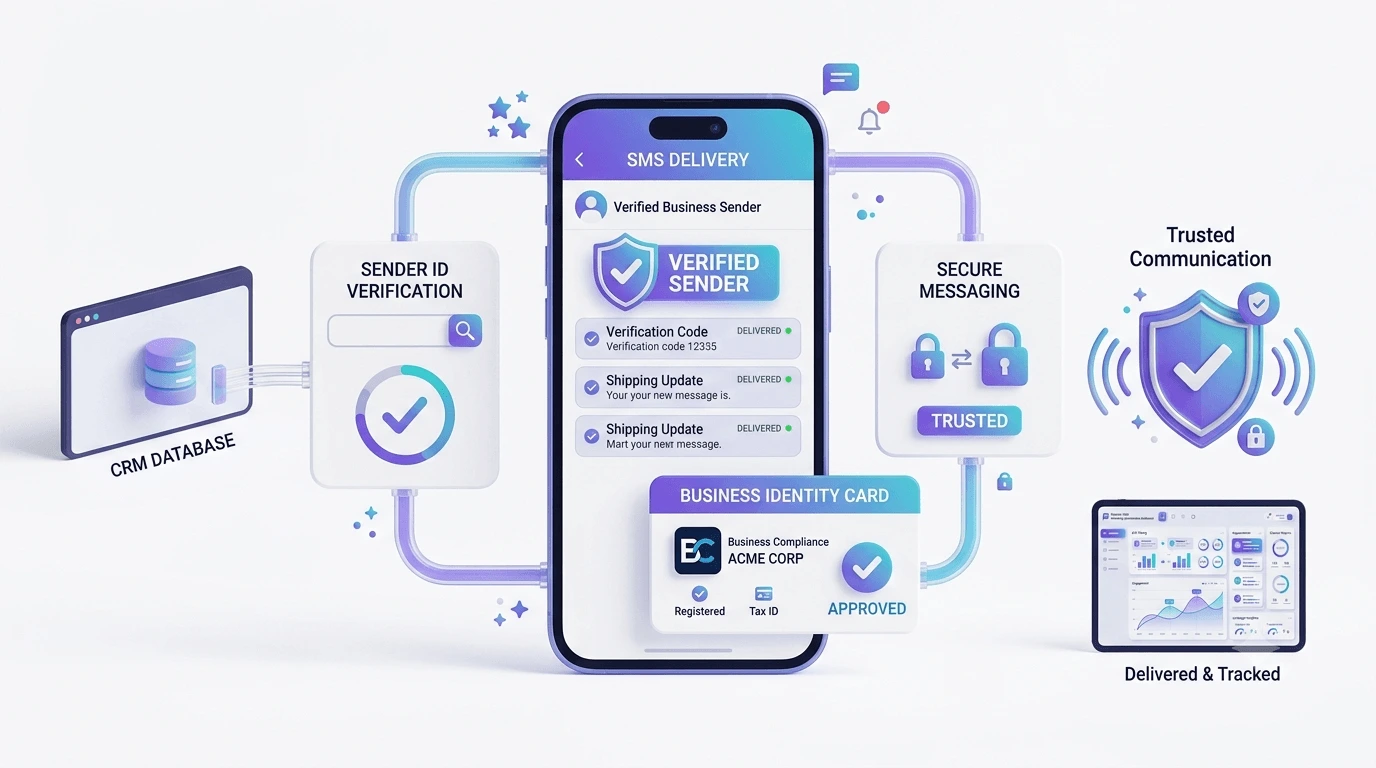
Compliance comes down to three main pieces of information, and carriers want all three on file before approving a business for higher sending volumes.
- Business registration: An LLC, Corporation, Ltd, Incorporated, or equivalent registration issued in the US, Canada, or the UK.
- Tax identification: An EIN or Tax ID in the US, a CCN in Canada, or a CRN in the UK, used to verify identity and ownership.
- An official business website: A live website showing your business name, services, and contact details, used as a basic transparency check.
How the registration tiers actually affect you
Not every business gets the same sending limits right out of the gate. Carriers assign throughput based on how thoroughly a business has been verified and how clean its sending history is. A brand-new registration with minimal verification starts with a lower daily message cap than an established, fully verified business with a track record of clean sends.
This is why two businesses using the exact same platform can have wildly different sending experiences. One might breeze through a 5,000-message campaign in an afternoon, while the other gets throttled and watches the same campaign trickle out over several days. The difference usually isn't the platform. It's the underlying registration tier.
Note: Throughput limits aren't fixed forever. As your registration matures and your sending history stays clean, carriers typically raise your allowed volume over time.
What happens if you skip this step
Businesses that try to send SMS without completing registration typically see one of two outcomes. Either messages get throttled and sent at a fraction of the intended speed, or they get filtered out entirely before ever reaching the recipient.
Neither outcome is obvious from the sender's side. Campaigns can look perfectly successful sitting in your dashboard, showing as sent, while carriers quietly drop a large percentage of them on the other end. You only find out something's wrong when customers start saying they never received anything, by which point you've usually already lost the moment that message was supposed to capture.
How MK TextBiz handles this for you
MK TextBiz collects all three required pieces, registration, tax information, and your website, as part of onboarding, before you ever send your first campaign.
This front-loads the paperwork so approval happens early, rather than discovering mid-campaign that messages are being filtered. By the time you're ready to launch, the compliance groundwork is already done.